
The Florist’s Daughter
In our final family photo, Mom, you stand at the center.
The shortest of the five, your arms encircle the two on either side like eagle wings. A mustard yellow turtleneck, just a shade darker than your hair, which has already lost the tightness of the curls you labored to create that morning.
Your smile. So warm. So radiant.
Kelly, beside me, looks fully away from the camera, ducking her shoulder to escape the talon pulling us into you. On the other end, Dana’s girlfriend wears a face half deer-in-headlights, half about-to-cry.
Me? I am trying to smile, yet all that shows is blankness.
Casey and David are already gone by now. Two of your children dead before you, and those of us who remain lean in behind that glass table, holding the pose another second.
We stand behind the dining room table in the last house you lived in. The glass oval is piled with platters of food, its nucleus a huge circular plastic plate of shrimp.
You’d wanted to host a party for years. Autumn. So we are here to help pull it off. We know there won’t be many more chances.
In my mind’s eye, I block out the rest of us and see just you. When I frame it right, you are as happy as you’ve ever been. You are. Genuinely.
For that shutter click moment.
I hear your voice: “We don’t talk about those things, Danny.”
· · ·
Before that glass table, before the bypass and the strokes, before the deaths of Casey and David — before your baby brother, the first David, was even born — you were already hiding under a table.
Elm Street. Rochester, New Hampshire. The Great Depression.
· · ·
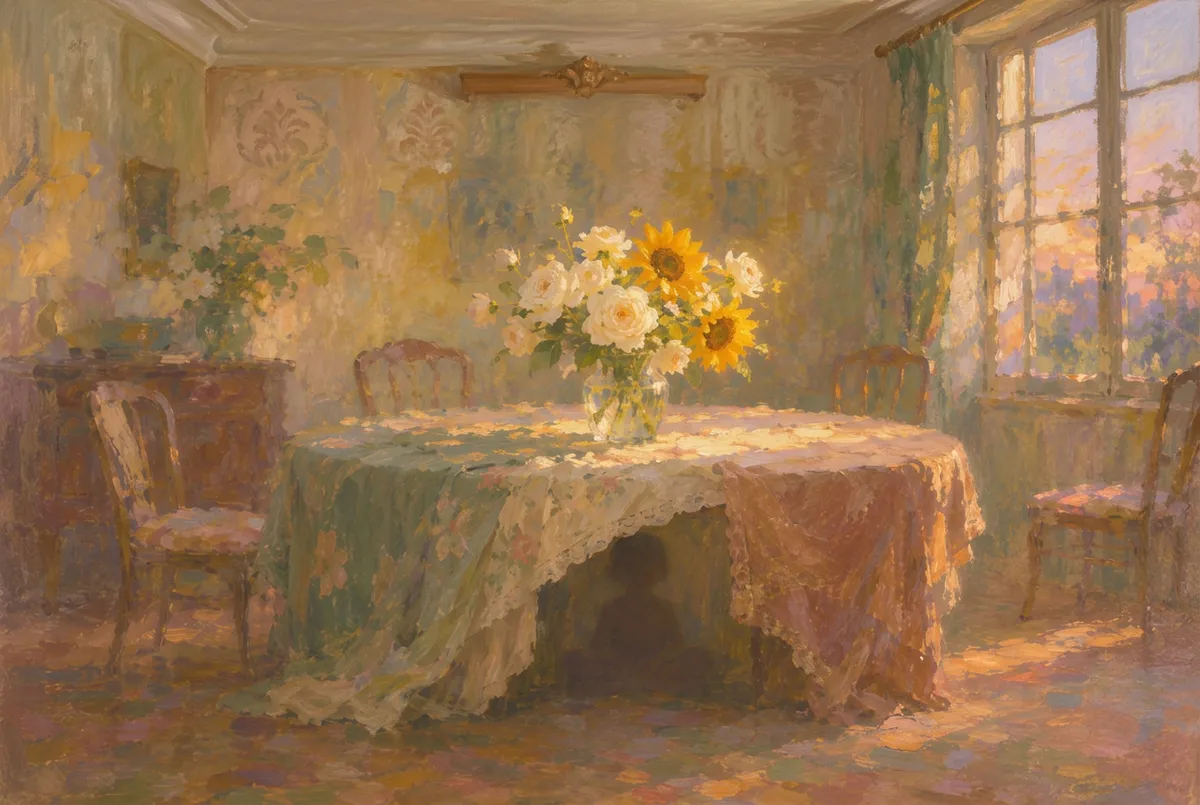
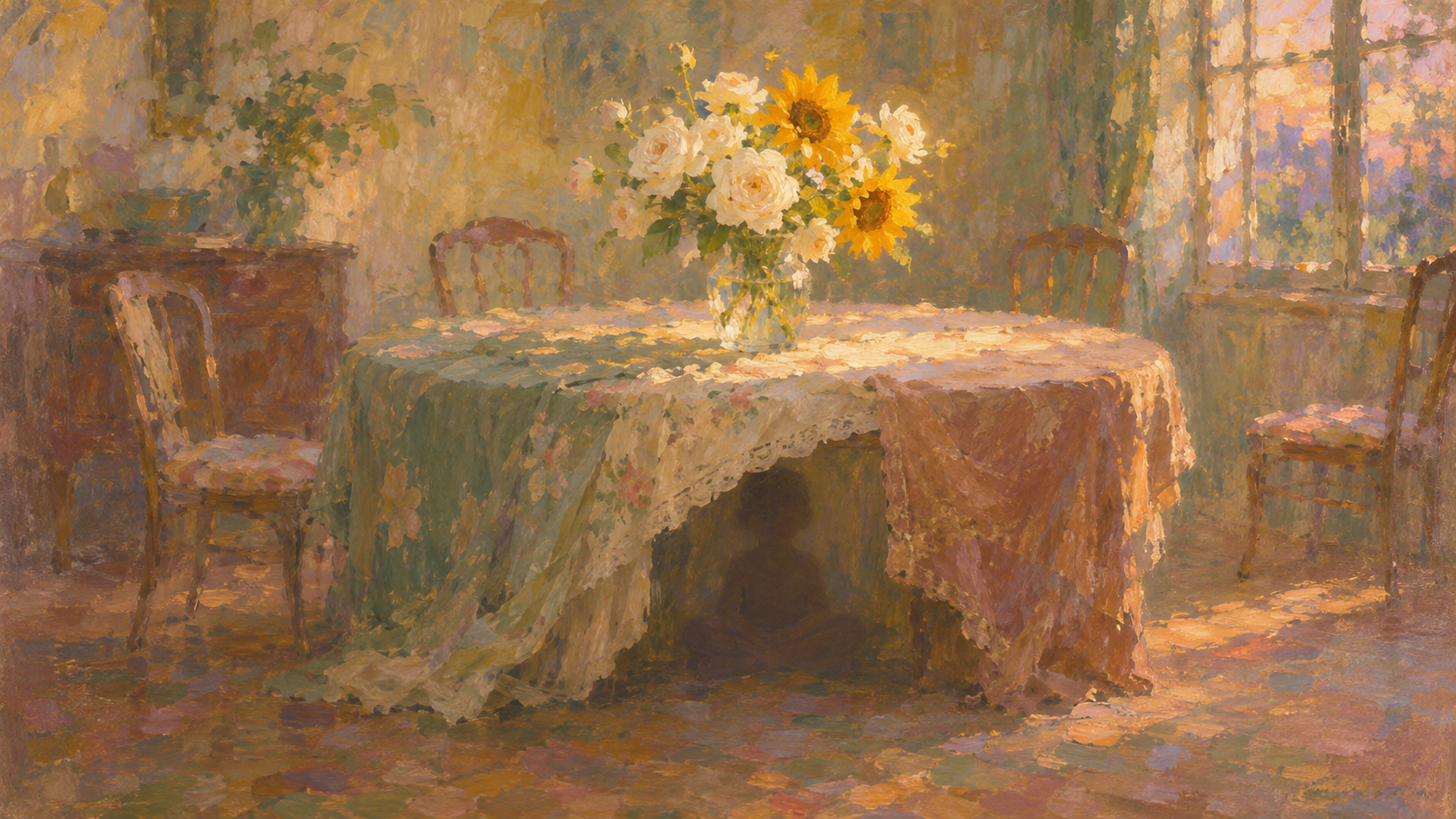
You’re always there under the round table in the dining room. The table I’ve never seen. Yet always known.
It was large enough that four people could dine. A bit cramped for six. Your parents weren’t entertaining. Not then.
The skirts of its cloth hung low, uneven, cornered. Your mother, my Grammy, would place two or three different cloths to cover it all.
You were a toddler then, and that dark and dusty room was never used. No one minded that you stayed for hours, sitting cross-legged behind the tablecloths as if they were a stage curtain. Your parents were busy surviving.
You’re always alone there under the table. Okay. Never alone. Always together with the chorus of imagination. That ever-present cast of what could be.
Tea parties with tiny cups and saucers. Gatherings of friends. Dramas of your imagination unfolding in the sanctity of that circular shrouded space.
These were quiet years in that house on Elm Street. Before David. Before the car. Your father at work, fighting to keep their florist business alive, selling beauty and celebration through the Great Depression’s leanest years.
Sometimes you’d go to the shop with your mother too.
When a customer made a purchase, your father would let you pick out the baby's breath and ferns to accompany the bright blooms. The damp mineral smell of the buckets clung to your hands.
Then you’d hold the white paper spread open as you carefully kneeled atop a stool by his work bench. Dry and dusty beneath the roses and lilies, it caught their scent.
When he’d wrapped the bundle and got the ribbon in place, it would be your precious pointer finger that held it all tight while your father fastened the knot. In the stillness it required of you, the lush floral smells mixed with the faint sourness of yesterday’s water.
Your mother was always in the corner of the work area, her back to the expanse of the room with its light and color. No matter how much she hunched or how hard she pressed the buttons on the adding machine, it never totalled into something to be happy about.
Then she’d shake her head and start again. A cloud of cigarette smoke hung around her, keeping the flowery fragrances at bay.
During the winter you turned five, she’d be home in the afternoons when you got back from Catholic school. With her belly growing, she started making dinners for the family. Sometimes she’d clean in the afternoons, singing along with the radio. Bing Crosby, Fred Astaire. Occasionally she even danced with the broom.
She started serving dinners in the dining room. Your mother and father talking about the flower farmers they worked with. Your father would tell the story of the fields of tulips he’d seen when he was a boy in Holland. They talked about their dream to move to California.
While you and your father cleared the table, she made ham and cheese or pastrami and cheese sandwiches for your father to take to work.
They wanted the baby to be a boy, after you and your sister. You didn’t care though — he or she would be someone to play with. Finally. Each time you pressed your hands against your mother’s belly and felt the faint kicks, the promise of companionship came closer.
Then, at the end of your fifth summer, your father drove your mother to the hospital. It was time.
You stayed with your sister and her boyfriend all day.
When your father came home that night, he told you and your sister that it was a boy. His shoulders hung forward and he smelled of sweat and disinfectant.
David, they named him.
It’d been a hard birth, your father said. David and your mother were spending the night at the hospital.
They didn’t come home the next day. Or the next.
And when they did, on David’s sixth day, he was in a box.
· · ·
Your mother seldom came downstairs anymore after that. When you arrived home after school, you’d stand at the bottom of the stairs and listen. Either silence, or sobs and moans.
From your post under the dining room table, even as you spoke to your ensemble, you’d freeze and go quiet when you heard your mother’s feet touch down on the floor above you.
The boards creaked when she walked to the bathroom. Each time, you hoped she’d come downstairs. Maybe she’d come into the dining room. Maybe she’d find you there beneath the table. Maybe she’d play with you.
Then came the sound of the toilet flushing. Her steps again. The closing of the bedroom door. The silence from above brought you back to your world below the table.
Had anyone noticed that for a time you hadn’t been there?
Did you continue the tea parties of your imagination?
Did you serve your dead infant brother?
Would he have aged beside you? Friend, company, ally. Protector maybe?
The tragedy of your brother could only be blamed on God. And He was not part of the household.
In the evenings the sounds beyond your table’s ring became your father’s voice. At first just background. Then, increasingly a call, drawing you out.
Despite it all, his monologue rang bright, his buoyancy nearly unsinkable. It was he who’d open the cans of beans, spread the saltines, narrating each step.
Sometimes he got your mother to come down and eat with you too. Now all the meals were back at the kitchen table.
· · ·
Years passed.
“You’ll be able to drive it too.”
Your father beamed at your mother from the driver’s seat, his teeth as bright as the chrome around him.
A brand new 1941 Cadillac Series 62 Convertible.
“But I can’t drive.”
“Sure you can. This beauty even has the new Hydra-Matic transmission.”
Your mom looked around at you as you hugged the back of her seat, so close you were almost sitting between them.
You didn’t know exactly what he meant, though he’d explained it several times. You did know he’d chosen this model for her.
“You don’t even have to shift.”
He tapped on the steering wheel.
“Just drive. Steer with the hands. Gas and brake with the feet.”
He always made the possible simple.
“But we can’t afford this.”
Your mother’s face squeezed back into its familiar folds.
“It’s already paid for.”
He grinned.
Keeping his left hand on the wheel, he reached over with the other and touched her face with the back of his fingers.
You were still smiling when your breath caught. You hadn’t seen the two of them together out of the house in years.
“But how? We can’t…”
He cut her off.
“After I started doing the accounting.”
He paused. You all paused. He’d taken over the accounting after David died, when your mother stopped going into the shop.
“I started putting away a little bit of cash every month.”
He turned onto the interstate heading east toward the coast.
Your mother caught her hat just before the wind whipped it off.
“But Gerald.”
“But Gerald nothing. Then with the weddings this month. And old man Hughes giving an extra big tip. And they gave me a good trade-in for the Buick.”
She still frowned. Your father had both hands on the wheel now as he got up to speed.
Then he reached toward her again, this time all the way across her shoulders, and tugged. She scooted in close beside him and he left his arm around her.
“It’s ours, honey. I paid in cash already.”
“But.”
“No buts.”
He kissed the top of her hat.
“We can be happy again.”
That’s when you sat back, felt the warmth of the July sun on the white leather.
· · ·
That night’s meal was on the dining room table. You and your mother had just decided not to wait any longer and started eating.
First came the sound of the car doors shutting hard.
Then your father’s voice.
“I’m okay, Harv.”
By then your mother had the front door open.
Your father took his arm from around the policeman’s neck and put his hand on the doorjamb.
“I’ll be fine.”
The policeman shook his head, a sad smile.
“He was lucky.”
Your father didn’t look at you or your mother, his gaze already fixed somewhere inside the house.
“I just need to lie down for a few minutes.”
They got him to the sofa.
He’d gone to the store to get cream for tomorrow’s coffee. On the way back, a drunk driver from Concord, returning from the beach, ran a red light straight into the Cadillac’s passenger-side front.
“But with neither of them having insurance—”
The policeman shook his head again.
“Gerald?”
Your mother’s voice, though not loud, silenced the policeman mid-sentence.
“Gerald? What does he mean ‘no insurance?’”
The room stopped. Every face turned toward your mother.
Your father’s eyes were closed now, his voice fading.
“I was going to call Richard and take care of it on Monday.”
· · ·
The country came out of the Depression, mobilizing for war. Your mother mobilized too.
Her husband wasn’t to blame for the loss of David. But the Cadillac — totalled, all their savings gone — was different.
What did you hear? What did she say to him in those rants? How often did her rage turn physical? What did he do when she hit him?
Years later you told me that after the car your mother got ugly all the time. Your phrasing puzzled me. Angry? Rageful? Violent?
I knew ugly as a word for appearance, not emotion.
He left just after the war ended.
How much did he take before he decided to go?
Was his exit silent? Was there an explosion?
Or like that eerie quiet of the mushroom clouds in the newsreels?
I asked you. Repeatedly.
Always the same response: “We don’t talk about those things, Danny.”
Then, with him gone — no one left to take her anger. And you had no one to lift you up. To scoop you from under the table and hold you to the light.
I don’t remember ever meeting your father.
He visited us once just before you and Dad split up. I was tiny. He was moving to California with his new wife. It was the last time you saw him.
We didn’t talk about that visit. Or about him.
Your mother stayed in that same house until she died sitting at the little, square kitchen table with its cracking formica.
Whenever you and I visited your mother, before she died when I was eight, she always served me Swiss Miss hot chocolate with the mini marshmallows. I sat at the table in the kitchen, spooning them into my mouth, like tiny white clouds, one by one.
I never saw anyone use the dining room. The promise of the sweet drink was always lure enough for me to come with you on those visits.
Your mother’s face was more wrinkled than any I had ever seen. The lines around her mouth seemed to hold even when she wasn’t speaking. Even then I had a word for it. Ugly, though I wouldn’t have dared speak it.
The static air, the lack of light in the house, made my legs jumpy, itchy to leave almost as soon as we arrived. Always silent. Always smelling of something darker than must.
· · ·
I was three and you and I were in the dentist’s waiting room.
I didn’t know.
We don’t talk about those things.
Certainly not “outside the family.”
I spoke. Not so loud. Yet the carpeted room was silent. The grown-ups staring vacantly down as they flipped through magazines. Even in the room meant to be comfortable, the antiseptic smell from the bright, metallic treatment area seeped in.
“Mom?”
“Yes, honey?”
“When is Dad coming home?”
I double did you there. First, I’d exposed you in front of strangers.
Then you had to play nice — a tight smile that even then I knew meant danger.
“We’ll talk about that later, honey.”
I hadn’t yet learned.
· · ·
Once, when I was ten and you finally let me stay by myself without a baby-sitter, I was awake later than I was supposed to be.
Propped up in bed with the clip-on lamp shining from my headboard, I was deep in the learning that I could disappear into books. Into worlds of dark and light, beautiful and ugly.
The room was unlit save for the spotlight on my book. I heard you opening the apartment door, quickly turned off the lamp, slid onto my side, and pretended to be asleep.
It didn’t occur to me that from outside the apartment you would have seen the light against the blinds.
The click of my bedroom door handle.
You softly: “Hi honey, you awake?” As if I might not be.
Me, feigning groggy:
“Huh, what? I was asleep.”
Then your voice dropped into a lower register.
“Lie to me, Mister? You’ll think twice about that next time.”
You flipped on the light as you exited the room, leaving me wondering what was coming.
The sound of the sliding glass door opening. Then closing. Then you were back with a branch. You called it a switch.
“On your belly. Pull your pajama bottoms down.”
It was alive. The end, where you’d separated it from the bigger branch, was green and stringy. The crags and nubs — what was on its way to becoming new growth — pierced my skin.
You were breathing hard when you finished. I was silent. Crying would have made no difference.
“Don't you lie to me again.”
I was still on my belly with my pants down when you turned out the light and closed the door.
I kept that switch beside my desk for years. It took months for the bloodstains to wash out of my pajamas.
My siblings were so much older than me. I ask them about their childhoods.
“What was it like growing up with Mom and Dad in the same house?”
“Fighting. A lot of yelling.”
I wonder: what’s uglier? The physical or the verbal?
· · ·
“Does your Mom know how close we are?”
Amy and I were bouncing and rattling on the train from college in Virginia to your house in Boston. Our first trip together. Three months in, still the honeymoon.
“What do you mean?”
“Because what I got you for Christmas… it implies intimacy.”
I didn’t know what she meant. Or how to tell her that you and I don’t talk about how close I am with a girlfriend.
I wish I could remember what Amy said to you that day. The three of us were seated in a semi-circle at the small round table in your apartment. Facing out a window toward the building next door. Beige bricks, old windows blanked by curtains.
We were eating a Christmas dinner that you’d made. Like the old days. Turkey, onion casserole, mashed potatoes.
I’d helped. Amy had helped. You were aglow.
She was the first girlfriend I’d brought home that you had liked. Smart, thoughtful, Amy genuinely wanted to know you when she asked about your first husband. About Texas.
It shouldn’t have been a big deal. Amy's mother was on her third husband then.
Amy didn’t know.
You didn’t answer her question. Just changed the topic. Your shoulders stiffened and your voice became taut.
Soon dinner was over and Amy and I carried the dishes from the dining room to the kitchen.
She whispered to me: “What happened?”
I didn’t know either. I’d registered the change in air pressure, my breath tightening. The sour sensation in my belly felt more familiar than noteworthy.
Later, when we were all three in the living room, the Christmas tree glowing gold and red in the bay windows that faced out to Beacon Street, you asked me to “help you with something” back in the dining room.
“Sit down,” you’d commanded me after the silent walk down the dark hallway to the dining room table.
I obeyed, less from the old childhood fear than curiosity.
“How could you have told her that I was married before?”
I blinked.
“Why wouldn’t I?”
“Because it’s none of her business is why.”
I saw your nostrils flare then. The boy I’d been would have read that sign and stopped.
“It’s no big deal, Mom. People get married, people get divorced.”
You leaned forward then, your breath acidic with stale coffee and cigarettes. You hissed:
“It may not be a big deal to you, but it is to me.”
I resisted the urges. To argue. To roll my eyes. To leave.
“We don’t speak of those things.”
That day you meant it as instruction. Command. Yet I was beyond your grasp. Out of striking distance.
Already a grown man.
At least bodily.
So you said “we.”
“We don’t talk about those things, Danny.”
Even then, something between us had ended. I would. Talk about it all. Betray your code.
But we didn’t talk about that either.
Amy and I left the next day. Two days before we’d planned. The Christmas tree lights were still on that morning as I packed the presents you’d given us and the ones Amy and I had given each other. We left the books I’d brought for you. The sweater and earrings Amy had given you.
You hadn’t said a word about the flannel sheets Amy had gifted me, which I’d unwrapped in front of you.
The silence of the apartment was too much.
· · ·
I only knew about your first husband because you were outed by your dead ex-husband, Ned. My father. The second husband.
I was a junior in high school when the alcohol finally beat my father. Your going with me to the funeral felt odd. You hadn’t seen him in more than a decade. Yet there was no playbook, and I was only fifteen.
After his funeral in Rochester, we drove back to Portland and Dana treated us to lunch at one of his favorite restaurants in the harbor.
We sat outside with two umbrellas shading the big round table with its white linen cloth and perfectly even hem. The rough planks of the pier, the faint give beneath us, the aftermath of my crying at the funeral. My belly roiled.
It felt odd to be eating lobster, yet Dana encouraged everyone to order what they wanted.
I recall him saying, “Everybody has a gift. My gift is people. What’s your gift?”
He asked us each in turn. I didn’t want to talk about it. His ebullience seemed out of place just after saying goodbye to our father.
I don’t remember what Kelly or David said.
Then came a side comment, just for you. We all heard him ask if you were going to get married again.
I didn’t hear his quiet addendum. Apparently no one else did either.
The next day you and I were on the plane back to Virginia, back to regular life.
“Danny, I have to tell you something.”
Oh no, I thought.
You were in the middle seat, me by the window.
“Remember when Dana asked me if I was going to get married again?”
I nodded, my chest sinking as I exhaled.
“Then he said, ‘They say the third time’s the charm.’”
That’s when you told me about your first marriage. That my brother David came from that man.
After you’d said what you needed, I leaned my head against the cool oval of the window, looked out into the clouds.
Right at the end of his life Dad must have told Dana. Spoke what he wasn’t supposed to.
I wonder if my father believed that he wasn’t supposed to say.
When you first married.
Or when he told Dana near the end of his life.
Or did he believe something else about speaking up? What prompted him to let the truth rise even as he was falling?
Dad had outed you. Then you had to tell David. You couldn’t risk him hearing it elsewhere.
We all knew the story of David’s name. You’d promised your mother that your firstborn son would carry the name of your six-day-old brother, the one who never came home from the hospital.
You told us part of the story about your courtship with my father too. Ned, just back from the war, had seen more of the world than most of Rochester’s bachelors. All the girls were after him.
Not you though. You weren’t chasing. It wasn’t just your beauty that drew him in. He’d gone off to war and come back having seen the world. You’d stayed in Rochester and lived through a marriage, a baby, a divorce. You’d both been somewhere others hadn’t.
You left out that you were divorced with a baby.
What I want to know is how much you believed what you told yourself.
That it was best not to tell my brother David who his biological father was? That believing my father was his had served him?
Maybe you even believed what you and Dad told yourselves: that you would tell David when he was older.
But then the right time never came.
Not even when Dad bragged about Dana’s judo and baseball while poo-pooing David’s track trophies. Track was a sissy sport.
What would they think?
We don’t talk about those things.
They who? The neighbors? The people at the church you didn’t go to anymore?
What would David think? That he was less than? Not part of the family? Different?
· · ·
After you told me David’s origins, I adjusted to another level of how screwed up our family was, padding on another layer of protection. Part of me was already counting the days until school was done and I could move out.
At least it cleared up my confusion in biology class. Dominant, recessive. Mom and Dad’s blue eyes. David’s brown.
Eventually I asked you about his father.
You’d smile, wistful, transported.
“We lived in a little upstairs apartment in Rochester. He’d be sweaty when he got home from work.
When I asked him why, he said, ‘I ran all the way home from work. I was so excited to see you.’”
I don’t know if that was before or after David was born.
I don’t doubt that you believed him. Even when I was sixteen, I wondered that you believed him.
But maybe I am wrong.
Who is to say?
· · ·
You at the center of the photo is right. It’s your party.
Beside the platter of shrimp: bowls of potato salad, coleslaw, chips. Through the window behind us, the discolored circle in the grass where the above-ground pool used to live is just visible.
For that shutter click moment you are the matriarch you always wished to be.
Still, Kelly can’t stand it another moment. She’s bailing.
As if the ducked shoulder weren’t sufficient, the look on her face. A poster-child-worthy demonstration of adolescent annoyance. The dance you two are still locked into twenty years later.
On your left is Dana. You can’t reach beyond him, though by some yogic miracle of shoulder flexibility your arm wraps up and around his neck.
He takes up the most real estate in the frame. Bigger than the rest of us.
His face is placid. Peaceful.
He and I had taken your car to Stop & Shop earlier to get the shrimp.
I drove. Dana rolled a joint.
“Mom thinks I drink too much.”
I thought so too, though I wouldn’t have said it. He was the closest of us to our father. My few memories of the two of them together—rare times I was with the men in our family—still carry the tang of cheap beer on their breath.
Dana lit the joint and I waited to see if he was going to say more.
I turned us onto Johnson Street, keeping my eyes on the road though I wanted to see his face.
He took a drag, passed it to me, then went on speaking with his breath held.
“She’s right. I do. What she doesn’t know is that I drink a lot more when I’m around her.”
He and I, we could talk about those things.
Beside Dana in the photo, his girlfriend is out of the reach of your hand. You’d exploded at lunch the day before, unleashed a noxious cloud of sarcasm that stunned the rest of us into silence and drove her crying from the table.
You told me once how you wished me and my siblings would smile and say “that’s just how Mom is,” our voices lilting with affection and understanding.
That your behaviors — so hard to be around — were nothing compared to the love in your heart. The harmony in your imagination.
Us not saying anything that day, even as Dana went after his girlfriend, was as close as we could get. Not because the behaviors were nothing. Not because your imagination wasn’t real. They were and it was.
We just didn’t know how to talk about those things. We didn’t dare.
The blankness on my face, the concealment there, isn’t because Kelly is trying to flee your grasp and I stand between the two of you.
You refused to speak with a therapist about Casey’s death or David’s.
This was after your heart’s first failure, your first attack.
After the quadruple bypass.
The stroke and aneurysm.
Blockages.
Attempts to open what had closed.
It’s not true that what doesn’t kill you only makes you stronger.
Sometimes it just takes a while.
We truly want to give you what your heart held.
In the photo, my struggle to smile: I want it too, that family. Happy.
I hadn’t learned to hold on to possibility amidst such evidence to the contrary. The dissonance was too much for me then. Sometimes what I saw around me seemed so far from the visions I held, potential became poison. Drugs made the gap easier to bear.
I am still learning from you. That extraordinary capacity to want what the heart wants. To pretend.
The blankness of my face in that photo? That is me not yet knowing. How to hold it all: longing, vision, reality.
You died before I became a father. I wish you could have known your granddaughter.
When she was ten I had a big financial setback. Money was tight for the first time in decades. At the grocery store, I started looking at the prices, tallying up the total in my head.
She always wanted to buy fresh flowers. I resisted at first.
That day, I said yes.
When we got home, together we unwrapped the bouquet from the plastic. Up came the cold, green, mineral smell that had clung to your hands in your father's shop.
I cut the stems on a slant, my fingers sticky with sap, while your granddaughter filled a vase at the tap. Then I lifted her onto the counter. Her knees pressed into my belly as I held the vase steady and she placed the flowers in one by one, her wet fingers leaving prints on the petals.
Day by day, while I struggled to rebuild our finances, even in a house where we had little, our dining room table held something alive.
Sometimes we chose the majestic gold sunflowers. Often we got the least expensive mixed bouquets. Her favorite was white roses. She would press her whole face into them and breathe.
· · ·
P.S. What did this stir in you? Comment below.
